
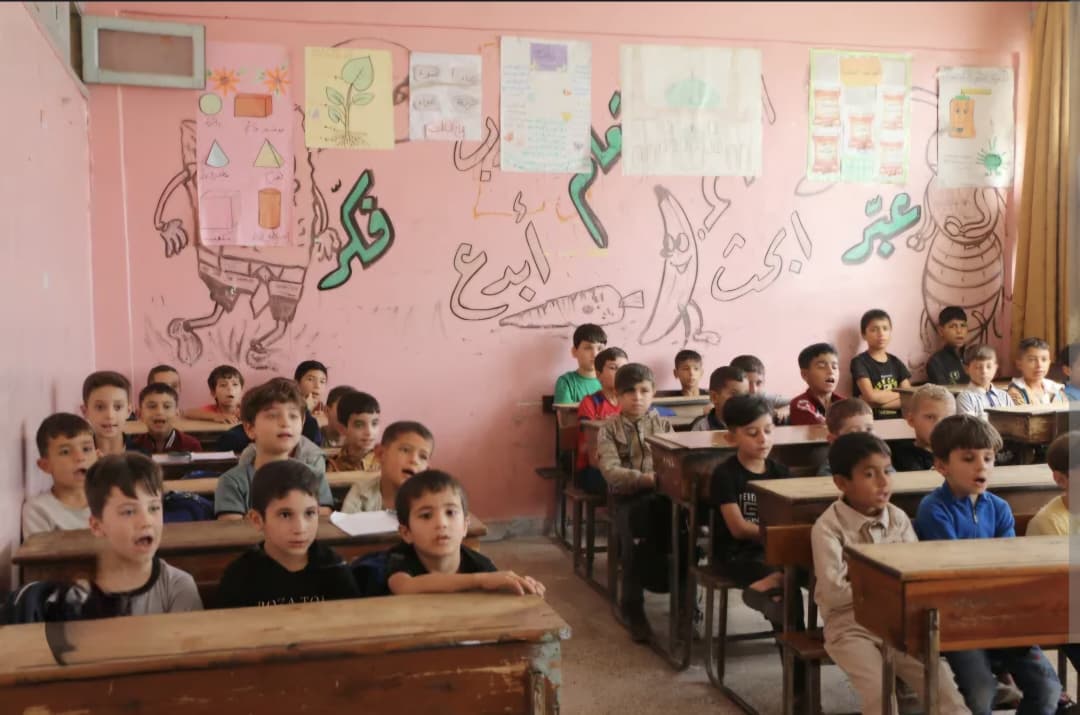
School bells will ring across Aleppo Governorate tomorrow, marking the beginning of a new academic…

Syria … A new Era
Syria today launched its new visual identity, in which the Syrian golden eagle embodies a new logo for the country, after being liberated from its previous form to acquire modern meanings, evoking the past to signify the restoration of the state, and looking to the future with different concepts that take into account recent changes.
The Syrian Golden Eagle symbol between the past and the present
In Islamic history, the eagle was a term present in the conquest of the Levant by the venerable companion Khalid ibn al-Walid in the battle of ‘Thaniya al-Aqab’. In modern Syrian history, the ‘Syrian golden eagle’ was an extension of what the founding fathers had written in 1945, which was embodied by the Syrian designer and visual artist Khaled Al-Asali as the emblem of the Syrian Arab Republic.
Between the old and new eagle… what has changed?
The 2011 revolution represented the first real collective engagement of the Syrian people in politics in five decades, for which millions of martyrs, displaced persons, detainees and wounded paid the price over fourteen years, breaking the chains that stood between them and their freedom and political sovereignty as citizens and owners of a great land and history. It was necessary to redefine the relationship between the state and the people in a new way, as expressed by President Ahmad al-Sharaa when he said: ‘A government that emanates from the people and serves them.’
The symbolism of the liberation of the three stars
The new design ended the forced fusion between the state and the people and rearranged their relationship in line with the circumstances of the present and the aspirations of the future. The three stars, which symbolise the flag in form and the people in substance, were freed and took a position above the eagle, which symbolises the state, after it was freed from its combative nature as a ‘gear.’
This people, whose ambitions embrace the stars of the sky, is protected by a state that defends it and provides it with everything it needs to ascend to its historical role after decades of obscurity. With its expected survival, it ensures the radiance and renaissance of this state and protects it from any imminent danger, as the stars surround and adorn the eagle.
The unity of the land and the unity of Syrian identity
The tail of the eagle has five feathers, each representing one of the major geographical regions: the north, east, west, south, and centre. It is the banner of Syrian unity in its most beautiful form.
As for the eagle’s wings, they are neither in an offensive nor defensive position, but rather in a state of balance:
- Each wing consists of seven feathers, for a total of fourteen feathers representing the combined provinces of Syria.
- This symbolic and symmetrical distribution emphasises the importance of each Syrian province and its role in the stability of the state.
- For this reason, Syria’s new emblem has become a visual political covenant, linking the unity of the land with the unity of decision-making.
The five messages conveyed by the new emblem
- Historical continuity: The eagle is not a break with the past, but rather an extension of the 1945 design, affirming the authenticity of Syrian identity through time.
- Representation of the new state: The eagle is the new Syria, a modern state born of the will of its people.
- Liberation and empowerment of the people: The liberation of the stars is the liberation of the people.
- Unity of Syrian territory: The tail of the eagle, consisting of five feathers, refers to geographical regions that are not differentiated or excluded, but rather integrated.
- A new national contract that defines the relationship between the state and the people.
This work was accomplished through authentic Syrian efforts, linking history, art, and cultural and civilizational heritage, which have shaped the identity and character of the Syrian people for decades. The visual identity was developed in line with the aspirations and highest values of the Syrian people, which were the basis of the blessed Syrian revolution and which the Syrian people have preserved to this day.

Related Posts
Comments (0)