
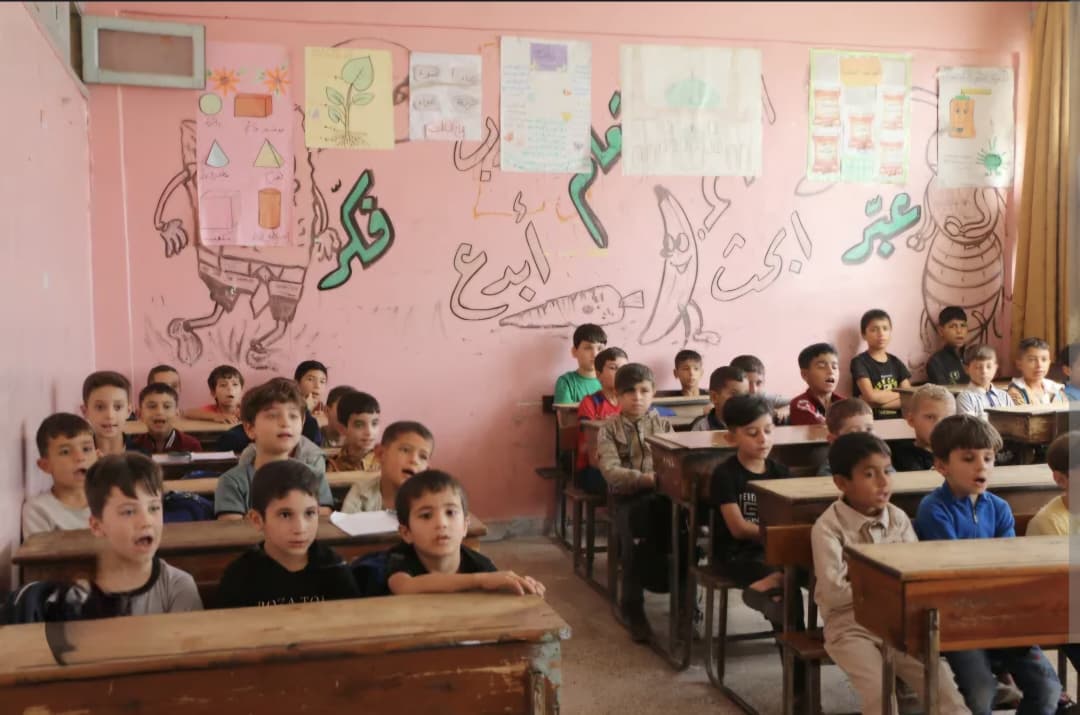
School bells will ring across Aleppo Governorate tomorrow, marking the beginning of a new academic…

Children of Aleppo: A generation lost between war and lack of education
After more than a decade of bloody conflict, the children of Aleppo are caught in a vortex of suffering that threatens their future and that of their entire community. In a city that was once a beacon of culture and education in Syria, children today are deprived of their most basic rights: Education, safety, and psychological care. According to reports by the United Nations and humanitarian organizations, more than half of Aleppo’s children are either out of school or suffer from deep learning gaps due to the harsh conditions imposed by the war.
Tragic reality: Children without education in a city without schools
- Schools were destroyed and turned into shelters
Before the war, Aleppo had hundreds of schools that welcomed thousands of students every year. Today, many of these schools have been reduced to rubble or used as shelters for displaced people. UNICEF says that one in three schools in Syria are either completely destroyed or unusable, while existing schools suffer from overcrowding and a lack of basic equipment such as desks and textbooks.
- Widespread school dropout
Difficult economic conditions have forced many families to pull their children out of school and send them to work to help their families make ends meet. Statistics indicate that nearly 40 percent of children in Aleppo have dropped out of school, while others have significant educational gaps due to years of irregular schooling.
- Severe shortage of educational staff
Thousands of teachers and academics have been displaced by the war, creating a huge gap in the education system. Today, many schools rely on volunteers who are not pedagogically qualified, which negatively affects the quality of education provided.

Psychological and social repercussions: A generation carrying the wounds of war
- Psychological trauma needs urgent intervention
The children of Aleppo have lived through bombing, displacement and loss of loved ones, leaving them with deep psychological trauma ranging from chronic anxiety and depression to post-traumatic stress disorder (PTSD). Save the Children says that one in four children in Syria suffers from psychological disorders that require specialized treatment, but psychological services are almost non-existent in many areas.
- High rates of child labor and underage marriage
Extreme poverty and economic collapse have forced many families to make difficult decisions, such as pushing their children into the labor market or marrying off their daughters at an early age. According to UN reports, about 30 percent of children in Aleppo are engaged in hazardous work, while rates of underage marriage have risen dramatically in recent years.
Possible Solutions: How can Aleppo’s generation be saved?
- Rebuild schools and provide a safe learning environment
- Repair damaged schools and equip them with basic teaching aids.
- Build temporary schools in remote areas and camps.
- Provide flexible educational curricula suitable for children who have missed years of schooling.
- Strengthening psychosocial support programs
- Train local cadres to provide initial psychological support to children.
- Establish specialized trauma centers for children.
- Engage children in recreational and rehabilitation activities to help them overcome the effects of the war.
- Scholarships and financial support for poor families
- Providing scholarships that include the cost of education, transport and stationery.
- Cash transfer programs conditional on children’s attendance at school to ease the economic burden on families.
- Encouraging vocational education as an alternative for children who had to drop out of school.
- The role of the international community and humanitarian organizations
- Increase funding for education in Syria.
- Support local initiatives that work to bring children back to school.
- Press for a permanent ceasefire to ensure a safe environment for education.

The children of Aleppo are not just victims of war, they are the future of this long-suffering city. Without urgent and coordinated intervention, the risk of losing an entire generation becomes a painful reality, exacerbating social and economic crises for years to come. But with the combined efforts of the local government, international organizations and civil society, there is still hope to save this generation and enable them to build a better future.
The question now: Will we leave the children of Aleppo as victims of global neglect, or will we act to save them before it is too late?

Related Posts
Comments (0)